
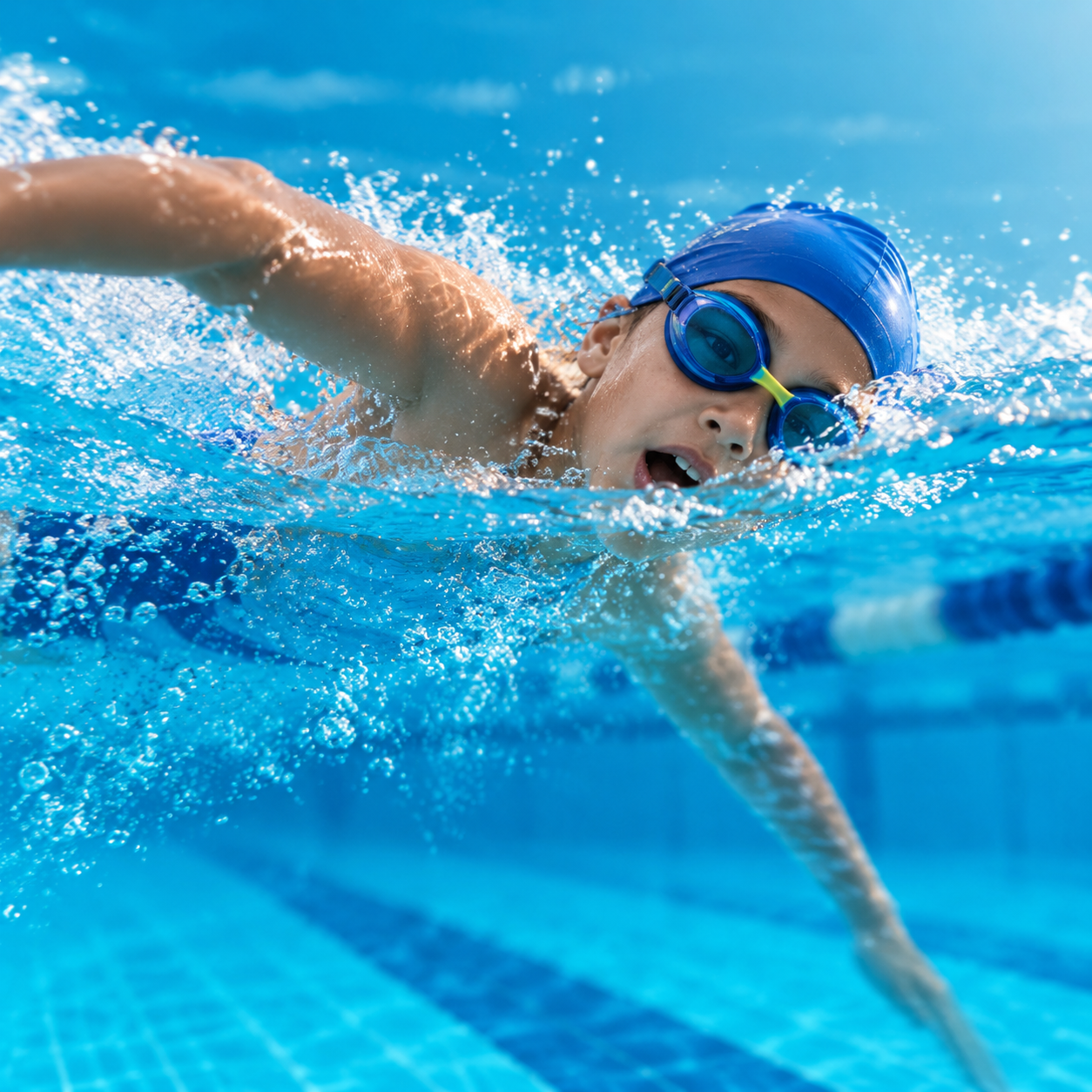
Your child can swim a decent stretch of front crawl, arms moving well, legs kicking steadily. Then it’s time to breathe, and the whole stroke changes for a moment. The head lifts. Water goes up the nose. The rhythm disappears.
It is one of the points where many children get stuck. Front crawl breathing asks them to coordinate an inhale and exhale while their arms, legs and body are already doing their own jobs. When the timing is off, the breath can affect everything else. Improving it usually means looking at the complete stroke rather than treating breathing as a skill on its own.
The basic sequence sounds simple enough: face in the water, breathe out, rotate the body, turn the head to the side, breathe in, then return the face to the water. In practice, a child is trying to remember all of this while also keeping their arms moving, maintaining their kick and staying in a good body position.
That is a lot to coordinate. The breath needs to happen within the stroke, so the rest of the movement can continue without interruption. Once the breath starts dictating what the arms and legs do, the stroke becomes harder to control.
A child lifts their head forwards instead of turning it to the side, which changes their body position and often causes the legs to drop. It makes sense as an instinct. Lifting feels like the safest way to make sure the mouth clears the water. In the stroke, though, it creates another problem to deal with.
The head should turn to the side as the body rotates, rather than lifting forwards. Keeping that movement controlled helps the swimmer maintain a more stable position in the water.
Some children hold their breath for as long as their face is in the water, then try to take a large breath as soon as they turn. That can make the breathing feel rushed and uncomfortable. The problem is often the timing of the exhale rather than the inhale itself.
A steadier pattern is to breathe out while the face is in the water, then take the next breath once the mouth clears the surface. That gives the swimmer less to do in the short moment available for the inhale.
Another common issue is a child twisting their neck to breathe while keeping the rest of the body facing down. That can make the swimmer feel unbalanced and often disrupts the stroke.
The head should turn as part of the body’s rotation rather than working separately from it. When the movement is coordinated, the swimmer can get the mouth clear of the water without having to twist excessively.
Then there is the opposite problem. A child becomes determined to get a full breath and rolls much further than necessary. The extra movement may feel safer, but it can throw the body off balance and make the next stroke harder to control.
The aim is a small, controlled turn to the side. The swimmer should get enough of the mouth clear to breathe without turning the whole body dramatically to do it.
This is often where the underlying issue becomes most obvious. A child turns to breathe and the whole stroke pauses with them. One arm stops moving, the other drops, or the kick speeds up because they are trying to recover their position.
Good breathing fits into the stroke rather than stopping it. The arms continue, the kick stays controlled and the breath happens as part of the same movement. Once that rhythm starts to feel natural, front crawl becomes much easier to sustain.
There is no single side every child has to use. Breathing to the side that feels more comfortable is a sensible starting point, particularly while they are still learning to coordinate the movement. Bilateral breathing, where the swimmer alternates sides, can be introduced as their technique develops.
For many children, breathing every two strokes to their preferred side is easier to manage initially. As their control improves, they can experiment with different breathing patterns without having to change the fundamentals of the stroke.
A few things parents can look for: the face returns to the water quickly after the breath, the swimmer exhales while underwater, the head turns rather than lifts, and the body rotates naturally with the breath. The forward arm stays supportive, the kick remains controlled and the stroke keeps moving through the breath.
The important part is how these pieces work together. A child can technically get a breath while still having a problem with the timing or body position around it.
Breathing is much easier to assess when someone can watch the complete stroke as it happens. A teacher in the water can see whether the problem begins with head position, body rotation, the timing of the breath, the exhale or the arm movement, then work on the part that is actually causing the issue.
That kind of feedback is difficult to get from a distance. Sometimes a small change in head position or timing is enough to make the rest of the stroke feel completely different.
Breathing problems are easier to work on when a teacher can see the stroke properly. At WCSA, our teachers stay in the water with swimmers, allowing them to observe technique closely, make corrections and give feedback in real time.
Ask us about technique-focused swimming lessons Hertfordshire and personalised swimming coaching to help your child improve their stroke, breathing and confidence in the water.
Frequently Asked Questions
Often because the breath is affecting the stroke around it. Lifting the head, holding the breath underwater or losing body rotation can all make breathing more difficult.
Usually the side that feels most comfortable to begin with. Children can develop bilateral breathing as their coordination and technique improve.
No. Lifting the head forwards can cause the legs to drop and affect body position. Turning the head to the side with the body's rotation is generally the better movement.
There is no single pattern that suits every swimmer. Breathing every two strokes on a comfortable side can be a useful starting point, with other patterns introduced as technique develops.
Focused swimming coaching Hertfordshire can help identify whether the difficulty comes from breathing itself or from something connected to head position, rotation, timing or stroke technique.