
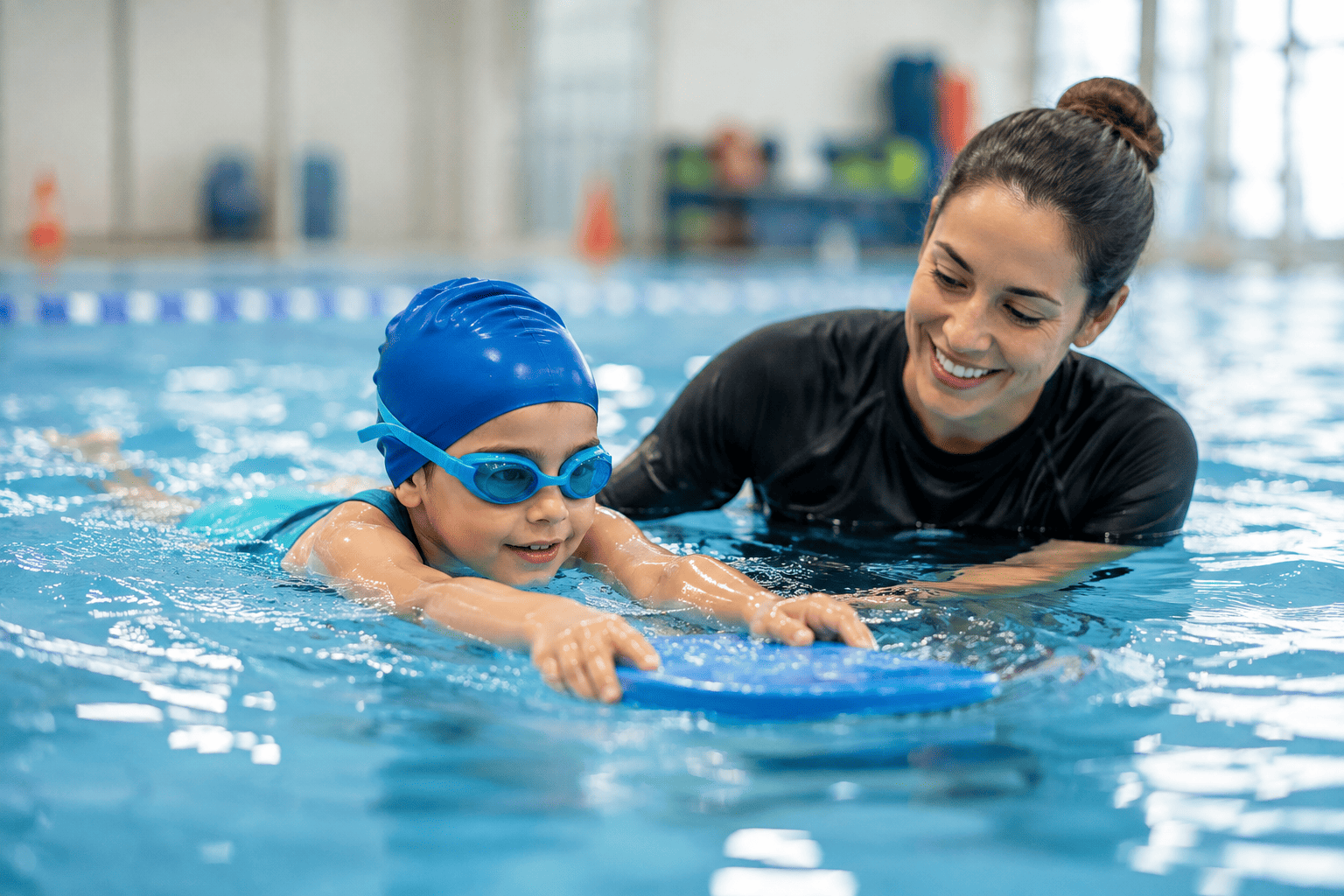
I often get asked “She’s swimming a length now. Does that mean she’s a proper swimmer?” or “He can do 25 metres on his own. So he’s basically there, isn’t he?”
I understand why we use distance as the marker. It is easy to see. Easy to measure. Easy to celebrate. And yes, when a child swims their first length without stopping, it is absolutely worth celebrating.
But I think we have accidentally made the length mean more than it does. Because swimming a particular distance tells you something about a child’s swimming ability.
It does not tell you everything.
A child can swim 25 metres and still have weak swimming fundamentals. They might be relying on an inefficient stroke, struggling with breathing, or using far more effort than they need to. They may be able to cover the distance, but that does not necessarily mean they are swimming well. In fact, a child who can swim 5 or 10 metres with good body position, controlled breathing and sound technique may have stronger foundations than a child who can cover 25 metres using an inefficient doggy paddle.
At WCSA, we think about swimming as three things working together: technique, confidence and progression. And once you start looking at swimming that way, “Can they swim a length?” becomes a much less useful question.
Let’s start with the obvious one.
If your child can swim 25 metres, that is brilliant. But the distance itself does not tell you how well they swam it. Did they maintain good body position? Was their breathing controlled? Were their strokes recognisable and efficient? Did their technique hold together from the first metre to the last?
Swimming is a technical skill. Distance should build from strong fundamentals, not replace them. A child should gradually increase how far they swim as their technique, control and confidence develop.
It is worth turning the question around. Would you rather your child swim 25 metres with poor technique, exhausting themselves to get there, or swim 10 metres with controlled breathing, good body position and a recognisable stroke?
The longer swim sounds more impressive. The better swim tells you more about what they have actually learned. Distance is useful as a measure of progression. But it should come after the fundamentals, not come at their expense.
One of the things I want children to develop is comfort in the water. Not recklessness. Not a belief that they are invincible. Comfort.
A comfortable swimmer understands how the water feels around them. They can put their face in. They can control their breathing. They can float. They can recover from an awkward position without immediately panicking.
That matters because water does not always behave the way a lesson does. A lesson is structured: There is a teacher, a wall nearby, a clear instruction and a predictable starting point.
Real life is rarely that tidy.
That is why water confidence, water safety and technique need to develop alongside distance. WCSA’s programme is built around exactly those three areas rather than treating swimming as simply a race to the next stage.
This is one of the simplest questions I would ask. A child swimming towards the wall is using forward movement, but what happens when they need to stop? Can they float? Can they turn onto their back, get their breathing under control and rest without becoming frightened?
There is a strange assumption that stronger swimmers are the ones who keep moving. Sometimes, the more important skill is knowing how to stop. A child who knows how to rest in the water has another option available to them when they are tired, and that is a very different kind of confidence from simply being able to swim further.
Another important distinction is direction. Swimming from one end of a pool to the other is relatively straightforward when you know exactly where you are going. Knowing how to respond when that changes is another matter.
Can your child recognise where the wall is? Can they turn around? Can they make their way towards an exit? Can they stay calm enough to make that decision?
These are the sorts of questions that sit underneath water safety. They are also why we put so much emphasis on building strong foundations rather than rushing children through levels simply because they can complete a particular distance. WCSA uses stage-based learning and assesses children in their first lesson so they can be placed at an appropriate level.
Here is one that catches people out: take away the goggles. I am not suggesting children should spend every lesson swimming without them. Goggles are useful, and for many children they make swimming considerably more comfortable. But I do think children should experience what it feels like to swim without them in a safe, supervised environment.
If a child has only ever experienced swimming with goggles, they can be surprisingly unsettled when those goggles disappear. The same principle applies more broadly. We want children to understand their own ability rather than become dependent on a very specific set of conditions. That is what confidence actually looks like. Not, “I can do this when everything is exactly how I expect it to be.” More, “Something changed. I’m still okay.”
This might be the most important question of all. Children do not become safe swimmers because they never make mistakes. They become safer because they learn what to do when they do.
A missed breath. A mouthful of water. A wobble. A tired moment. A lost pair of goggles. A swim that suddenly feels harder than expected. We want those experiences to become manageable rather than frightening.
That is one reason WCSA places so much emphasis on confidence alongside technique. Our teachers are in the water with children, which allows them to give closer attention and make corrections in the moment while keeping lessons calm and supportive. The goal is not to make children fearless. It is to help them know what to do when they feel unsure.
For me, it looks something like this. They can swim a useful distance, control their breathing, feel comfortable putting their face in the water, float and recover, change direction and find the wall. They can manage without goggles when necessary, tread water and stay calm when something unexpected happens.
And perhaps most importantly, they understand their own limits.
That last one is often overlooked. Confidence in the water is not believing you can do everything. It is knowing what you can do, knowing what you cannot yet do, and knowing what to do when you find yourself somewhere in between.
Maybe. And if they can, celebrate it. Really celebrate it.
But then ask a better question: what can they do when the 25 metres are no longer the important part?
Because learning to swim is not simply about getting from one side of the pool to the other. It is about building strong fundamentals, developing sound technique, and then gradually increasing distance as those skills become increasingly automatic, reliable and useful.
Ultimately, it is about helping a child feel that the water is somewhere they understand, rather than somewhere they simply know how to move through.
That is the kind of swimmer we want to help create at WCSA: A child who knows what to do in the water and feels confident enough to do it.
– Cory Abrahams, Founder, Water Creations Swim Academy
https://wcsacademy.co.uk/